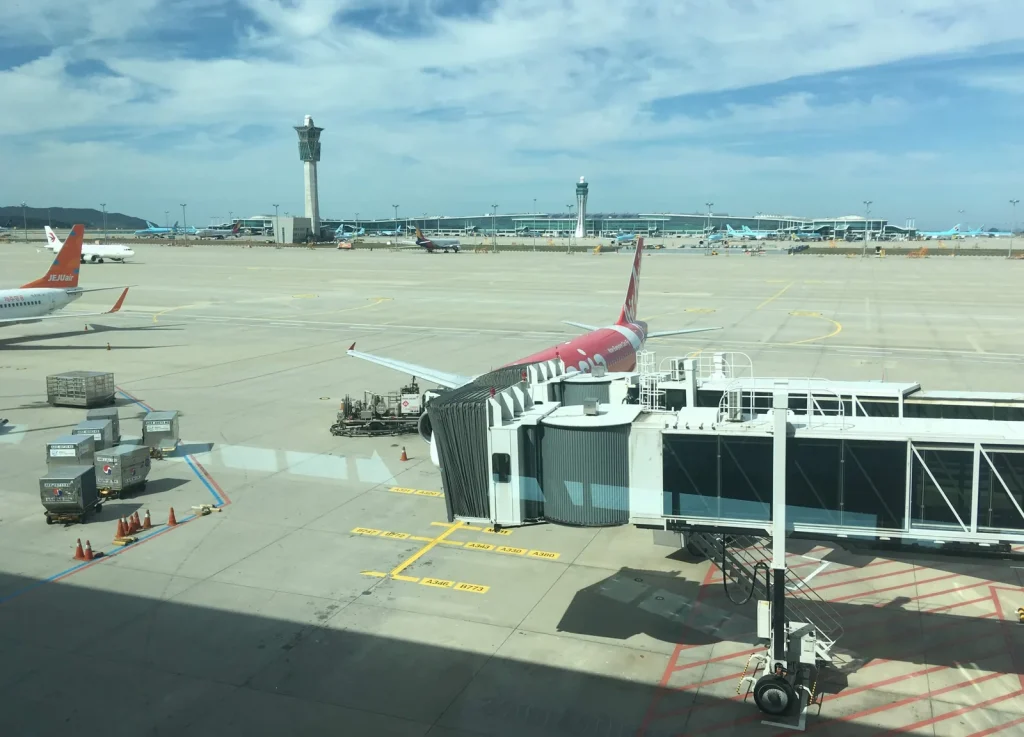
Featured image — Archive airport exterior: Christophe95, Wikimedia Commons, CC BY-SA 4.0. Proportionally resized; not a photograph of security screening.
On an international departure from Incheon, a toddler’s flight-needed milk and an adult’s oversized lotion bottle do not follow the same liquid rule. Pack so that distinction is easy to explain.
A half-empty bottle is not necessarily a small bottle. Under Incheon baby food rules, however, the ordinary container limit is not the whole answer either. The airport allows an exception for flight-needed food and drink when traveling with a young child. The practical job is to distinguish that supply from the toiletries beside it.
This guide concerns security screening for an international flight departing Incheon Airport, with a baby or toddler traveling with you. It does not apply U.S. TSA rules to Korea, cover an unaccompanied shipment of milk, or determine what food your destination permits you to import.
Start with the item, not the size of the bag
Incheon’s English security FAQ sets the ordinary liquid, aerosol, and gel limit at containers of 100 mL or less, inside one transparent resealable one-liter bag per passenger. Container capacity counts even when only a little product remains.
The same FAQ allows quantities needed during the flight of young children’s milk, water, juice, and liquid or gel food. It does not publish a universal allowance in milliliters per child. That makes “all baby products are exempt” an unreliable packing rule: purpose and the traveling child’s needs matter.
Our packing method uses three groups. These are editorial organization suggestions, not three bags required by the airport.
- Ordinary liquid toiletries. Check the capacity printed on each container. Put compliant containers in the ordinary liquids bag. A product does not become exempt just because it is marketed for children.
- The baby’s or toddler’s flight supply. Keep the needed food and drink accessible, with the package information available. You should be able to identify what it is and explain that it is for the child traveling with you.
- Items that need a separate answer. Ask about a particular cooling pack, unusually large supply, or another uncertain item before relying on the food exception. A cooler’s contents are not all the same thing for screening purposes.
Two 150 mL containers can lead to different decisions
Consider an illustrative packing check, not an approval of a particular bag. Container A is a 150 mL lotion bottle with 60 mL left. Container B holds milk intended for the accompanying two-year-old during the flight.
For A, subtracting used lotion does not fix the ordinary container limit: 150 mL is still greater than 100 mL. For B, the useful question is whether it is the child’s needed in-flight supply under the exception. Reducing both containers to the same “150 mL” label loses the reason the rules differ.
We deliberately do not turn that example into a suggested feeding quantity. A baby’s needs and the journey vary, and the FAQ does not provide a standardized milk calculation. Nor does the exception mean you can assume that any amount labeled “for a baby” will pass without questions.
A useful packing note is therefore specific: item name, container capacity, whether it is an ordinary toiletry or child feeding supply, and what remains uncertain. It is more actionable than a general reminder to “check liquid rules” at the airport.
Resolve the uncertain item before checking the large bag
Once checked luggage is gone, changing the packing plan becomes harder. If an item falls outside the clearly described case, use the airport’s official guidance or contact channel before that handoff. The aim is not to negotiate a new rule at screening; it is to avoid discovering that the food exception never answered your actual question.
That is a separate handoff from a stroller. If you are flying Korean Air, our stroller-return guide explains why the return location should be confirmed independently. And if your itinerary involves a terminal change, the Incheon terminal-transfer analysis explains why a train’s running time is not the entire transfer.
Our editorial judgment: the best improvement is not buying more tiny bottles for everything. It is separating the ordinary liquid test from the child’s feeding exception, then resolving the few items that fit neither clearly. That can reduce unnecessary repacking without promising a screening outcome.
For families dropping luggage in the city, make the same packing check before using Seoul Station’s airline check-in service. An earlier bag handoff moves this decision earlier too. If the trip changes to a different departure airport or your child is outside this baby’s-and-toddler’s scope, start with that airport’s applicable guidance rather than carrying this example over.
Checked September 22, 2026 against Incheon Airport’s security FAQ, including its liquid-container and infant-food answers. Packing groups and the two-container example are K-Trend analysis. Security screening and destination food-import requirements are separate checks.