FAMILY TRAVEL · THE DECISION DETAILS
The convenience-store Tmoney refund limit depends on where you stop: a regular physical card with exactly ₩20,000 left falls outside GS25’s published limit, but within 7-Eleven’s limit. CU and emart24 accept balances up to ₩30,000 under Tmoney’s listed rules. For a family with several cards, check each balance before choosing the refund stop.
This guide covers normally functioning physical Tmoney cards and convenience-store balance refunds. Climate Cards, mobile Tmoney, damaged cards, and other transport-card brands have different procedures. The plastic card’s purchase price is not returned with the ordinary balance refund.
The difference between “under” and “up to” ₩20,000
Tmoney’s normal-card refund table, checked September 9, 2026, sets these convenience-store limits and lists a ₩500 refund fee. The table distinguishes a balance below ₩20,000 from a balance of ₩20,000 or less.
| Store group in the operator’s table | Eligible balance | Does exactly ₩20,000 fit? |
|---|---|---|
| GS25 | Less than ₩20,000 | No |
| 7-Eleven and the listed participating independent outlets | ₩20,000 or less | Yes |
| CU and emart24 | ₩30,000 or less | Yes |
Treat these as eligibility limits, not a guarantee that every nearby checkout can complete a refund at the moment you arrive. Ask the store before making it a tight departure-day stop.
The Korea Tourism Organization’s transport-card guide, checked September 9, provides a useful overview. For a boundary such as exactly ₩20,000, use the card operator’s more specific table rather than a general statement that convenience stores handle small refunds.
Three cards mean three fee calculations
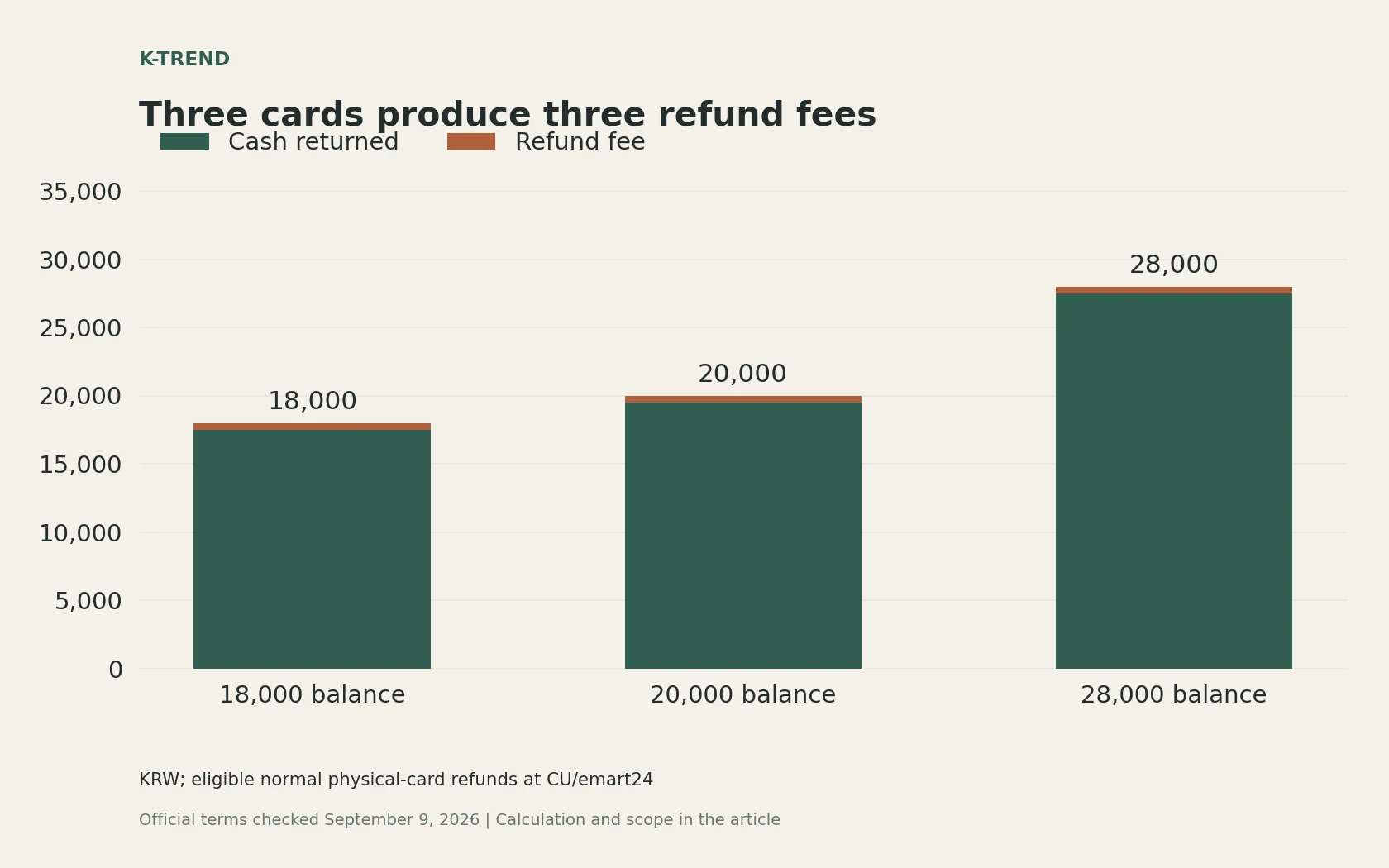
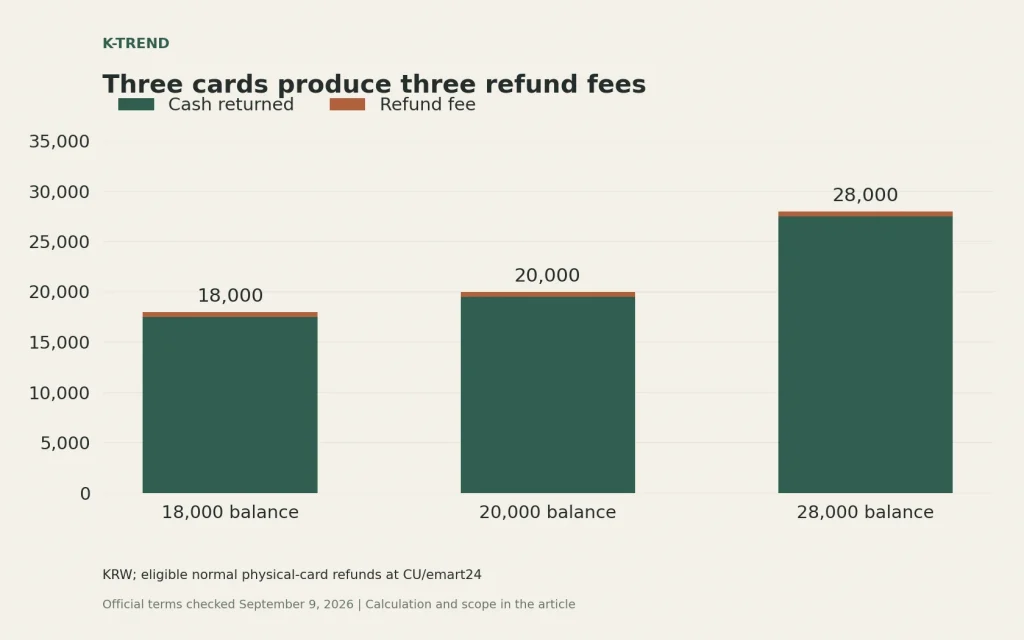
Suppose a family has three eligible physical cards with ₩18,000, ₩20,000, and ₩28,000 remaining. All three balances fit the operator’s listed CU/emart24 ceiling. Assuming each normal refund is accepted with the listed ₩500 fee, the cash calculation is:
| Card balance | Refund fee | Modeled cash returned |
|---|---|---|
| ₩18,000 | ₩500 | ₩17,500 |
| ₩20,000 | ₩500 | ₩19,500 |
| ₩28,000 | ₩500 | ₩27,500 |
| ₩66,000 combined | ₩1,500 combined | ₩64,500 |
Do not subtract one ₩500 fee from the ₩66,000 household total. These are three separate cards. At GS25, only the ₩18,000 card fits the published limit; at 7-Eleven, the first two fit. Choosing a suitable outlet can remove the need to split this modeled errand between stores.
This example does not apply the low-balance waiver shown for mobile refunds to physical-card convenience-store refunds. It also does not assume that balances can be pooled or partially refunded at a convenience-store checkout.
Do not empty the card before the final ride
Mark the last transit journey on the departure plan before choosing a refund time. Refunding a card and then needing to recharge it adds a second errand and can leave another small balance. If the card is still needed for the airport-bound route, decide where the refund can reasonably happen afterward—or whether retaining a small balance is preferable.
For a card above the convenience-store limits, stop using the small-balance table. Tmoney lists other channels with additional conditions. Its ATM option requires a suitable account in the cardholder’s own name, so it is not automatically convenient for a short-term U.S. visitor. Larger or special refunds need a separately confirmed plan.
Do not confuse the cash refund of transport credit with a shopping tax refund. Our Korean purchase-tax refund guide concerns eligible shopping receipts, not money stored on a transit card.
Our take: pick one feasible stop, then compare the hassle
We would check every family card’s balance while there is still flexibility in the day. In the modeled example, one outlet that accepts all three cards is more useful than discovering the limits one card at a time after joining a queue.
For the remaining day of a trip, additional rides will change each balance and may change which refund channel fits. If another Korea visit is already planned, keeping an eligible reusable card and some balance may be a reasonable alternative; that is a convenience choice, not a promise about future service terms.
Use the Seoul subway child-fare guide to budget the remaining city rides. A short-term Climate Card is a different product, so do not transfer this ₩500-fee worksheet to its refund rules.
Sources and checks
Original K-Trend calculation graphic. Inputs and assumptions are given above. View chart.
Terms checked September 9, 2026. Calculations use the stated examples; travel conditions and offers can change.