FAMILY TRAVEL · THE DECISION DETAILS
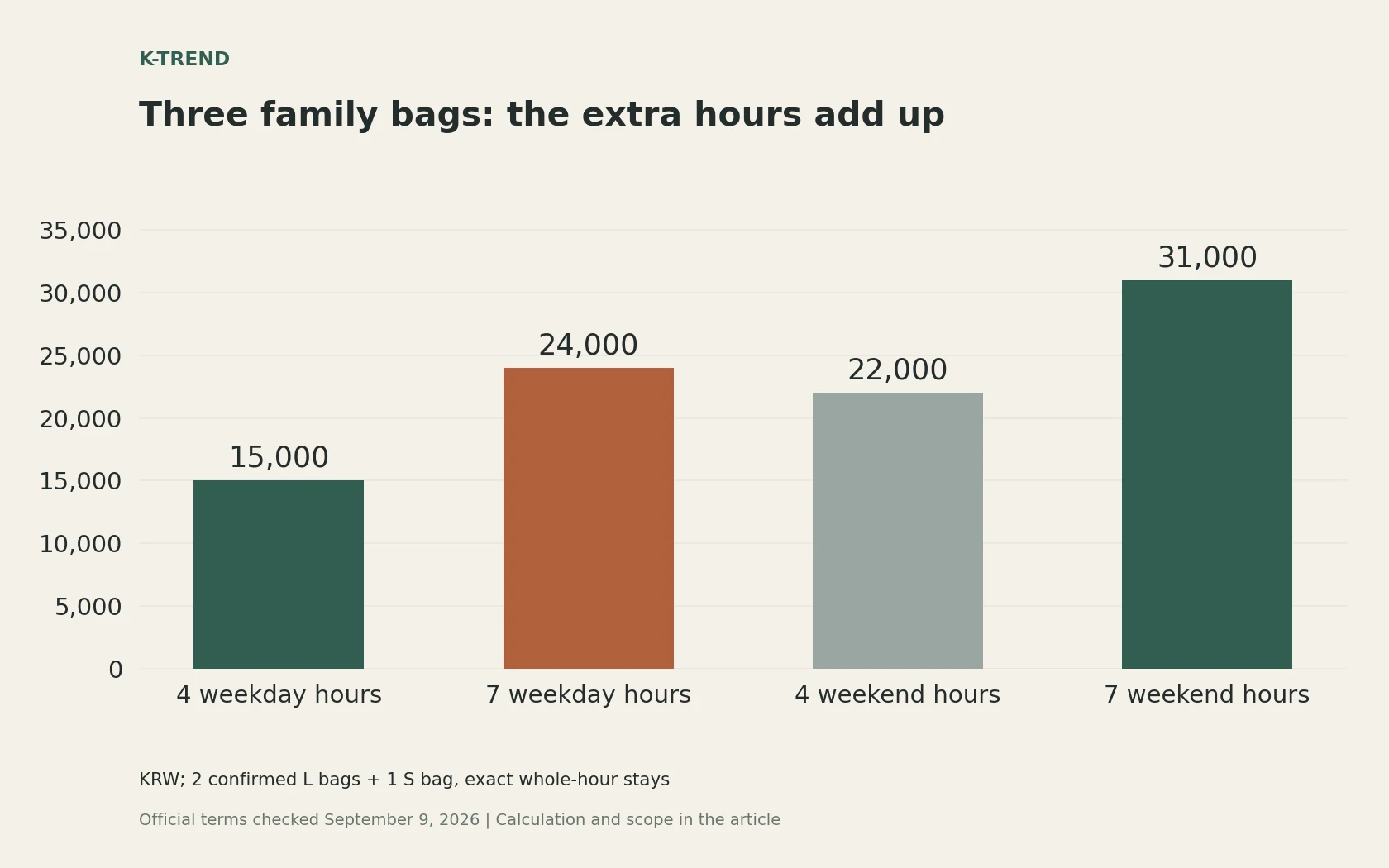
Seoul Station luggage storage at the staffed T-luggage counter is priced per bag, so three family bags incur three extra hourly charges. Two large bags and one small bag stored for seven hours produce a modeled ₩24,000 weekday total or ₩31,000 weekend total under the posted size-based rates—not one flat locker fee.
The other limit is retrieval time. The operator lists its Seoul Station service from 9 a.m. to 10 p.m. A late flight does not make a later pickup available. This guide covers the staffed T-luggage service, not an automatic T-locker or airport luggage delivery.
Start with the four-hour base, then count every bag
T-luggage’s operator rate and location page, checked September 9, 2026, lists a four-hour base by size. The relevant weekday rates are ₩6,000 for L and ₩3,000 for S; weekend rates are ₩9,000 and ₩4,000. Additional storage is listed at ₩1,000 per hour.
Have the counter confirm each bag’s size tier. A suitcase’s marketing size can be an unreliable substitute for the storage operator’s classification, particularly near a tier boundary.
| Modeled booking: two L bags and one S bag | Weekday | Weekend |
|---|---|---|
| First four hours | ₩15,000 | ₩22,000 |
| Three additional hours for all three bags | ₩9,000 | ₩9,000 |
| Seven hours total | ₩24,000 | ₩31,000 |
The weekday base is (2 × ₩6,000) + ₩3,000 = ₩15,000. Three additional hours cost 3 bags × 3 hours × ₩1,000 = ₩9,000. The weekend difference comes from the base tiers; the modeled extra-hour charge is unchanged.
This calculation uses exactly seven hours and the stated S/L classifications. It does not assume how partial hours are rounded, how overnight storage is billed, or whether a special-date rate applies. Get those points quoted if they affect your booking.
A 10 p.m. closing time belongs before the airport trip
The operator places its Seoul Station counter on B1, in the direction from Exit 1 toward Exit 2. Its location page lists 9 a.m.–10 p.m. hours. The Korea Tourism Organization’s storage-service guide, checked September 9, also distinguishes the four-hour storage rates from delivery fees. Use the selected counter’s current hours for the booking.
Build the final day backward from pickup, not from the flight. Leave time after collecting the bags to reach the correct platform or bus stop, obtain any required ticket, and travel to the airport. A bag collection scheduled at closing leaves no room for a delayed meal, missed train, or wrong exit.
As a planning example, dropping bags at noon and collecting them at 7 p.m. fits the seven-hour calculation. A noon drop followed by an 11 p.m. pickup does not fit the listed same-day retrieval window, regardless of willingness to pay more. That second plan needs a confirmed alternative service or a different collection time.
The cheaper hotel option has a route cost
Ask the hotel whether it can hold luggage after checkout and when it must be collected. Do not assume it offers free storage or can keep every item. If it does, compare the detour needed to return there with the quoted station-storage charge.
Suppose the station service costs the modeled ₩24,000 and a hotel offers storage at no additional charge. The station option is not automatically wasteful: it may remove a substantial backtrack. Equally, paying for station storage has little value if the family already plans to pass the hotel on the way out. The comparison needs the whole route, not just two counter prices.
Our AREX Express versus All-Stop guide helps with the next leg from the city. Confirm the correct terminal using the Incheon terminal-transfer guide before treating Seoul Station as the last decision point.
Buy a simpler departure, not unused storage hours
Our view is that staffed storage earns its fee when it removes an awkward luggage detour and leaves a comfortable collection window. It is less compelling when it merely relocates bags from a hotel the family will revisit anyway.
For the next trip, adding one extra bag adds another size-based base charge and another hourly charge after four hours. Shortening this modeled stay from seven hours to four would remove ₩9,000 of extra time across three bags. Changed rates, classifications, special-date terms, or counter hours require a fresh quote.
If the family continues by intercity train rather than heading to the airport, price the KTX child’s assigned seat separately. Storage and passenger fares solve different parts of the departure day.
Sources and checks
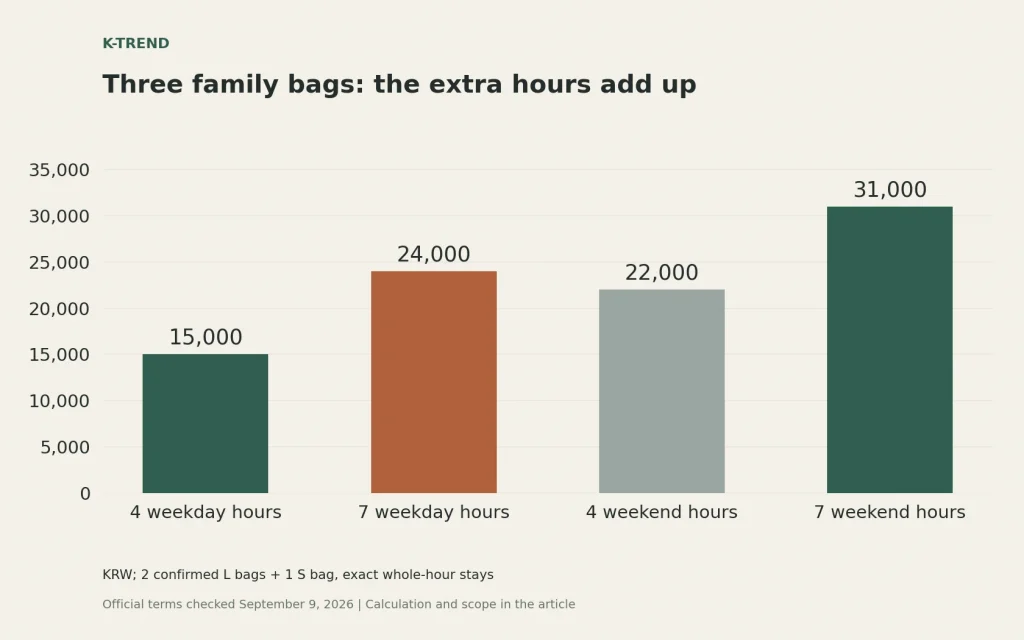
Original K-Trend calculation graphic. Inputs and assumptions are given above. View chart.
Terms checked September 9, 2026. Calculations use the stated examples; travel conditions and offers can change.