
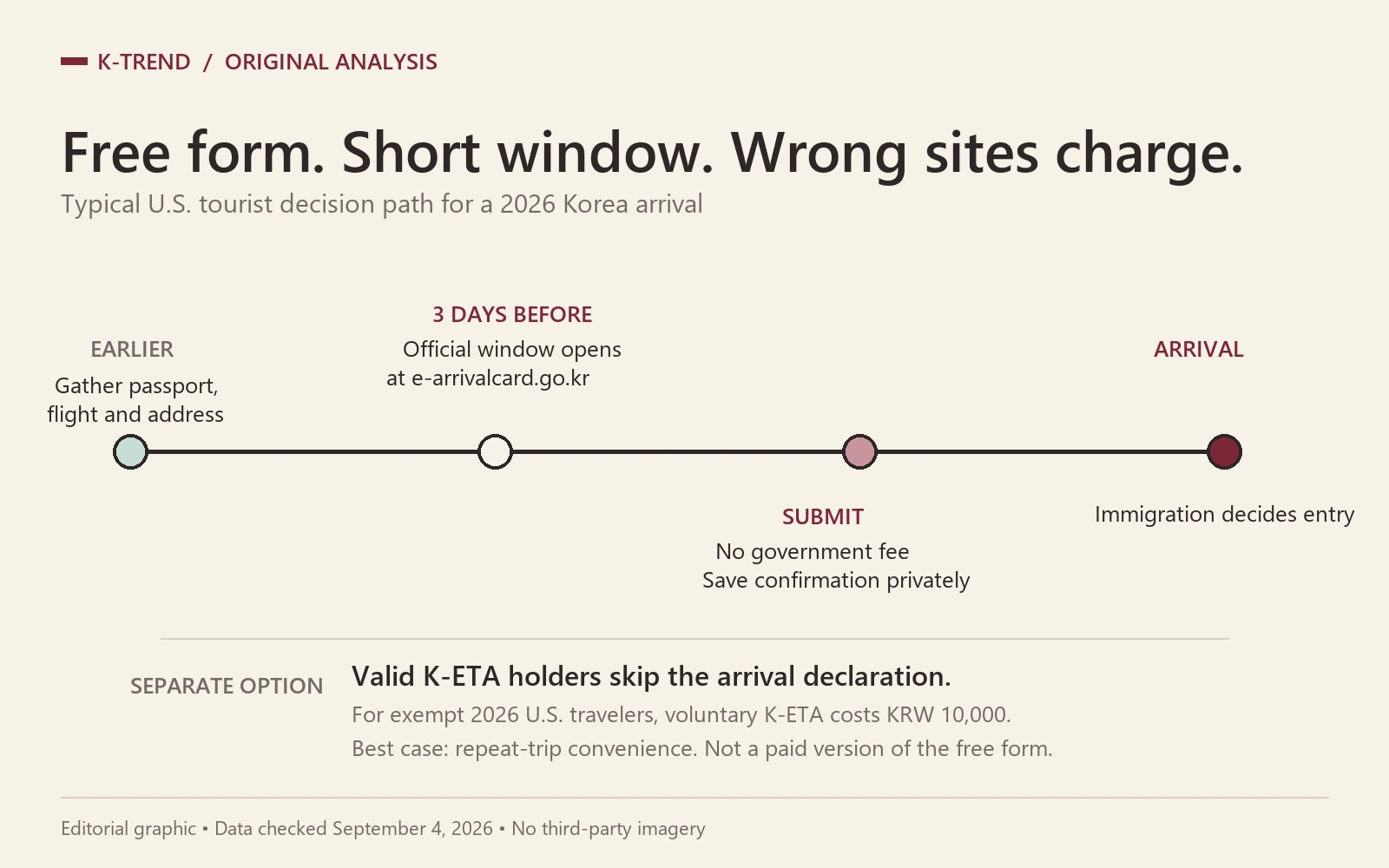
A U.S. tourist arriving in South Korea in 2026 usually does not need to buy K-ETA, but that does not mean there is nothing to submit. If you do not hold a valid K-ETA, complete Korea’s official electronic arrival card within the three-day window before arrival. The form is free.
The distinction matters because paid look-alike sites blur two different systems. The e-Arrival Card is a no-fee immigration declaration. K-ETA is a separate electronic travel authorization that currently costs KRW 10,000. For a typical one-off U.S. leisure trip in 2026, the free arrival card is usually the cleaner path.
K-ETA exemption currently applies
Submit the free e-Arrival Card
Open the form within 3 days before arrival
The fast answer for a U.S. passport holder
For ordinary tourism or business of 90 days or less, the U.S. Department of State’s South Korea page says a visa is not required and U.S. travelers are exempt from K-ETA through December 31, 2026. An official Korean consular notice also lists the United States among the countries covered by the temporary exemption.
Korea’s official e-Arrival Card eligibility guide draws the next line. Travelers with a valid K-ETA are excluded from the arrival-declaration requirement. K-ETA-exempt travelers are among those who must make the declaration unless another listed exclusion applies.
| Traveler situation | K-ETA | e-Arrival Card | Cost in this guide |
|---|---|---|---|
| U.S. tourist, 2026, no valid K-ETA | Temporarily exempt | Submit within 3 days before arrival | Free |
| Traveler already holding a valid K-ETA | Use the valid authorization | Excluded under the official guide | No new e-Arrival fee |
| Exempt traveler who voluntarily buys K-ETA | Optional in 2026 | Can avoid the arrival declaration while valid | KRW 10,000 plus possible card-related charges |
| Arrival on or after Jan. 1, 2027 | Current U.S. guidance says required | Recheck before travel | Rules may change |
This is an entry-form decision, not a promise of admission. Immigration officers make entry determinations, and travelers with visas, residence status, military status, crew status, or other circumstances should use the official eligibility guide rather than this U.S.-tourist shortcut.
“Within three days” is a submission window, not a planning deadline
The official Korea e-Arrival Card site says the declaration can be submitted beginning three days before arrival. The practical move is to prepare earlier, then submit only after the window opens and your flight and first-stay details are stable.
Do not read “three days” as “three calendar days before departure from the United States.” A long itinerary can cross dates and time zones. Work backward from the scheduled arrival in Korea, and use the date shown by the official portal. If the flight number or accommodation changes after submission, review the site’s correction instructions instead of assuming an old declaration will follow the new itinerary.
A household traveling for Chuseok has an extra reason to separate entry paperwork from domestic transportation. The Chuseok 2026 KTX booking guide covers Korail’s sale and payment deadlines; those reservations do not replace immigration declarations. Train confirmation, airline itinerary, and lodging address belong in one travel folder, but they solve different problems.
The official form needs information, not a payment card
The government portal describes a short sequence: enter an email address, provide passport information, add arrival and stay details, review the declaration, and submit. A passport scan or camera capture may help populate fields, but the traveler remains responsible for checking every character.
- Start from the `.go.kr` domain. Use
e-arrivalcard.go.kr, not a sponsored result that resembles it. - Match the passport. Names, nationality, passport number, and expiration date should be read from the document, not memory.
- Use the actual arrival itinerary. Enter the carrier and arrival information requested by the portal.
- Use a reachable Korean address. Keep the hotel or host details available before the window opens.
- Review before submitting. A fast scan is not enough when one transposed digit can break the match.
- Save confirmation privately. Keep it with the travel documents; do not post passport or confirmation data publicly.
The official site states that the service is free and warns that any site requesting payment for the e-Arrival Card is not the official service. That warning is unusually useful because “application assistance” pages can make a free declaration look like a paid government requirement.
When paying for K-ETA can still make sense
The temporary exemption does not block an eligible traveler from applying voluntarily. Korea’s official exemption notice says an exempt traveler may obtain K-ETA and avoid the arrival card while the authorization remains valid. The official K-ETA application page lists a KRW 10,000 fee and says assessment generally takes up to 72 hours, although some cases can take longer.
Paying can be rational for a frequent traveler who expects repeated eligible entries and values not filing a declaration each time. It is harder to justify for one 2026 trip when the free form solves the immediate requirement. The fee is also not a speed-up fee for immigration, and an application does not guarantee entry.
There is another boundary: the official notice says a previously issued valid K-ETA remains usable during the exemption and its fee is not refundable. If you already hold one, do not buy another simply because an arrival-card reminder appears.
| Factor | e-Arrival Card | Voluntary K-ETA |
|---|---|---|
| Government fee | Free | KRW 10,000 |
| When to act | Within 3 days before arrival | Generally allow at least 72 hours; longer is possible |
| Best fit | One trip with stable details | Potentially repeated eligible trips |
| Main risk | Forgetting the short submission window | Paying an unnecessary or nonrefundable fee |
Three scam checks before entering passport data
First, inspect the domain. The arrival form belongs on a Korean government `.go.kr` site. A polished page, Korean flag, or high search position is not proof.
Second, inspect the price. The official e-Arrival Card is free. A checkout screen is not an optional government upgrade; it is evidence that you have left the official route. K-ETA is the separate service with the KRW 10,000 government fee.
Third, limit the data trail. Passport numbers, dates of birth, flight details, and lodging addresses are sensitive. Do not upload them to a chat, social post, travel forum, or unverified assistant service just to have the form completed.
Families coordinating equipment, gifts, or resident benefits should keep those decisions separate from a visitor’s entry declaration.
Editorial evaluation
K-TREND ORIGINAL ANALYSIS: The most expensive error here is not the KRW 10,000 K-ETA fee. It is confusing a paid authorization with a free declaration, then handing passport data to the wrong site. The three-day window creates urgency, but it does not justify skipping the domain and fee checks.
EDITORIAL EVALUATION: My recommendation for a typical U.S. tourist making one eligible 2026 trip is straightforward: use the free official e-Arrival Card and set two reminders, one four days before arrival to gather details and another when the three-day window opens. A voluntary K-ETA is a convenience purchase for repeat travel, not the default answer.
Conditional outlook for 2027 travel
The exemption is currently scheduled through December 31, 2026, Korea Standard Time. The U.S. State Department says K-ETA will be required beginning January 1, 2027. Treat that as the current planning rule, not a permanent promise. Travelers crossing the year boundary should recheck both the Korean K-ETA notice board and the U.S. country page before buying or submitting anything.
That recheck is especially important when a trip is built around a dated event such as Seoul Fashion Week. Event dates may be stable while entry rules move. Lock the event, transport, lodging, and border requirements as separate records.
Official sources and scope
- Korea e-Arrival Card official portal: free-service warning, timing, and filing steps.
- Official eligibility guide: who must declare and who is excluded.
- Official K-ETA temporary-exemption notice: extension through December 31, 2026 and voluntary-application option.
- Official K-ETA application information: fee and processing-time boundary.
- U.S. Department of State South Korea information: U.S. traveler summary and current 2027 direction.
Guidance was checked September 4, 2026. This article covers a typical short U.S. tourism or business visit; it is not legal advice, a visa assessment, or a guarantee of admission. No affiliate links, paid application referrals, firsthand immigration claims, or generative images are used.