Discover Seoul Pass includes selected tourist transport benefits, but ordinary subway and city-bus travel on its physical card still requires a loaded balance. The ₩90,000 72-hour pass is not an unlimited Seoul transit ticket.
The Seoul Tourism Organization’s pass guide, checked September 30, 2026, separates free tourist transportation from the physical card’s prepaid transit function. That distinction matters when a family already budgets for a Climate Card, Tmoney balance, or separate airport journey.
Put attractions, transport, and stored money in three lines
The current official guide lists the 72-hour pass at ₩90,000 and the 120-hour pass at ₩130,000. It also describes Pick 3 Basic at ₩49,000 and Pick 3 Theme Park at ₩70,000, with separate selection conditions. The time passes run from activation and allow one visit per included attraction; they do not provide unlimited repeat entry.
The physical Card Pass can serve as a transit and prepaid card after topping up. The Mobile Pass is a different format. A tourist benefit such as an eligible AREX or airport-bus use has its own listed route and conditions. Ordinary subway spending should not be silently placed in that same free-benefit bucket.
Our decision worksheet uses three lines: the pass purchase, any stored transit balance you still need, and any excluded transport or admission. Only subtract a transport ticket from the third line after confirming that your chosen pass supplies that exact journey. A shared brand or a railway symbol is not enough.
Why a ₩20,000 margin can disappear
Use the price you would genuinely pay for each planned eligible activity, including available standalone discounts. Do not compare a discounted pass against an inflated list-price itinerary that the family would never buy. Assign zero to a benefit you will not use, including an eSIM if your existing plan already meets the need.
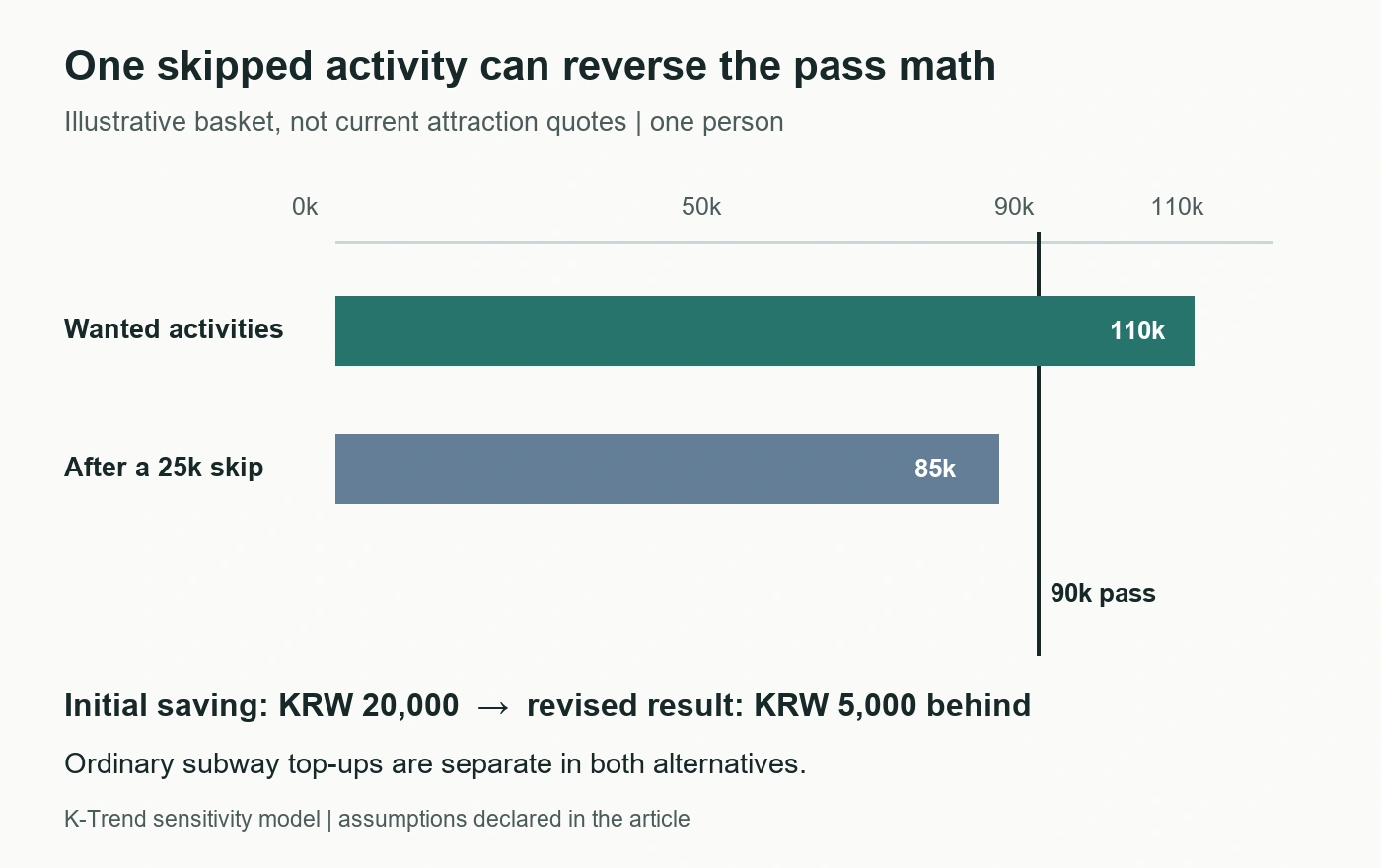
Here is an illustrative one-person model, not a set of attraction quotes. Suppose confirmed eligible purchases you actually intend to make total ₩110,000 without the pass. A ₩90,000 pass gives an initial potential saving of ₩20,000, before any remaining charges. If ₩25,000 of that basket disappears because the family skips an activity, the retained value falls to ₩85,000: ₩110,000 − ₩25,000.
The arithmetic then changes from ₩20,000 ahead to ₩5,000 behind. Adding ordinary transit top-ups to both alternatives does not restore a saving, because those costs were never covered in this comparison. Counting every advertised benefit as cash saved would hide that reversal.
K-Trend would buy the pass when the family’s feasible, individually wanted benefits comfortably exceed its cost within the activation window. We would use standalone tickets when the result depends on squeezing in an activity nobody particularly wants. A three-day product can be a poor fit for three days containing arrival, a long rest break, and departure.
Give each family member an honest basket
A child may have a free or lower-cost standalone admission where an adult does not. That reduces the child’s avoided spending. An adult calculation is therefore not a reason to assign the same saving to every family member. Confirm the pass product’s own age and ticket conditions with the operator before purchasing for the child.
For examples of different baskets, the palace article distinguishes foreign-child admission, while our N Seoul Tower budget keeps cable-car transport apart from observatory entry. The Climate Card calculation covers an entirely different transit product.
Before activation, verify the selected pass’s current partner list, entry procedure, remaining time, and exact airport-route benefit. For the planned trip, the favorable case survives only while those confirmed inclusions and the family’s intended uses remain in place. A partner change or abandoned activity requires recalculating that person’s basket.
Official sources, checked September 30, 2026: Seoul Tourism Organization product, transport and activation guide and Discover Seoul Pass operator. The ₩110,000/₩25,000 example uses declared hypothetical basket inputs; it is not advertised current attraction pricing.
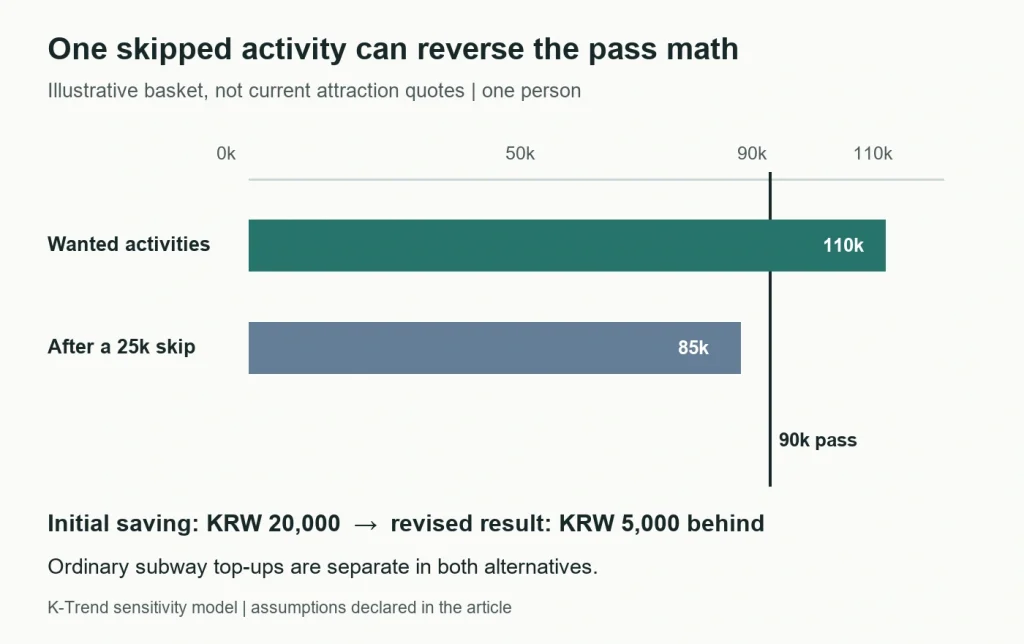
Original non-generative K-Trend sensitivity chart. The ₩110,000 basket and ₩25,000 skipped activity are explicit hypothetical inputs, not advertised attraction prices. View the featured image.