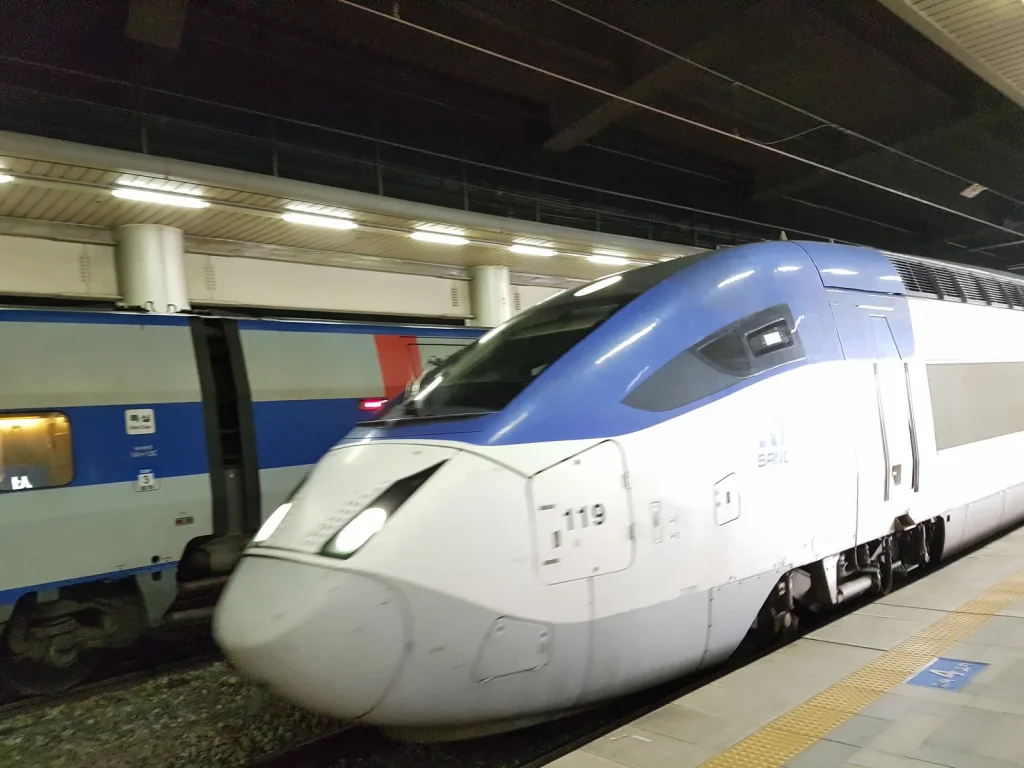

AREX Express vs All-Stop is best understood as a narrow family decision, not a generic Seoul tip.
For two adults traveling from Incheon Terminal 1 to Seoul Station, AREX Express costs ₩26,000 at the ₩13,000 adult fare. The All-Stop train costs ₩9,500 at ₩4,750 each. The family pays ₩16,500 more to save about 16 minutes on the published airport-to-Seoul Station times: 43 minutes versus 59.
That comparison is valid only for Seoul Station. A hotel near Hongik University or Gongdeok can make All-Stop better even before price enters the decision, because it serves those stops directly while Express runs nonstop to Seoul Station.
In this guide
Fact lock: Terminal 1 numbers
Seoul's official airport guide lists about 43 minutes for AREX Express from Terminal 1 to Seoul Station and 59 minutes for All-Stop. The corresponding adult fares are ₩13,000 and ₩4,750. Two adults therefore compare ₩26,000 with ₩9,500.
These are train times, not hotel-door times. Waiting for the next departure, walking from baggage claim, buying a ticket, reaching the platform and transferring after Seoul Station all sit outside the headline duration.
Terminal 2 changes the minutes, not the method
From Terminal 2, the official comparison is about 51 minutes on Express and 66 on All-Stop. The All-Stop adult fare is ₩5,350, so two adults pay ₩10,700 versus ₩26,000. The gap is ₩15,300 for roughly 15 minutes.
Families should confirm the arrival terminal before saving a screenshot of the math. Moving between terminals because the wrong route was planned can erase the small time advantage being purchased.
| Case | Value | Cost | Boundary |
|---|---|---|---|
| Terminal 1 Express | 43 min | ₩13,000 | Seoul Station nonstop |
| Terminal 1 All-Stop | 59 min | ₩4,750 | Serves Hongik and Gongdeok |
| Terminal 2 Express | 51 min | ₩13,000 | Seoul Station nonstop |
| Terminal 2 All-Stop | 66 min | ₩5,350 | More intermediate stops |
The destination-stop test
Express is a nonstop airport-to-Seoul Station product. All-Stop serves intermediate stations including Hongik University and Gongdeok. A traveler staying near one of those areas should compare the direct All-Stop arrival with an Express trip that still requires another train, taxi or walk.
Seoul Station is favorable for hotels nearby and onward KTX travel, but a tight rail connection needs more buffer than the nominal 15 or 16 minutes. Immigration, baggage and terminal walking are higher-variance parts of the trip.
K-TREND ORIGINAL ANALYSIS: value the saved family minute
K-TREND ORIGINAL ANALYSIS: The two-adult Terminal 1 premium equals about ₩1,031 per minute saved. Add a fare-paying child and the cash premium rises. That metric is not a universal value of time; it exposes what the route is asking the household to buy.
The premium can be rational after a long flight, with heavy luggage, or when avoiding an extra transfer has real physical value. It is harder to justify when All-Stop reaches the correct neighborhood directly and the schedule is loose.
Luggage and seating are not captured by the clock
Reserved seating and a more controlled Express environment can matter to families managing luggage and a sleeping child. All-Stop behaves more like a metro service and can grow busier as it approaches central Seoul. Those differences are experience factors, not guaranteed outcomes on every departure.
Count the number of adult hands available after one person controls the child or stroller. A one-transfer route that looks efficient on a map can become awkward when each adult already has a suitcase.
| Case | Count or route | Cost | Meaning |
|---|---|---|---|
| 2 adults, T1 | ₩26,000 | ₩9,500 | ₩16,500 |
| 2 adults, T2 | ₩26,000 | ₩10,700 | ₩15,300 |
| T1 time saved | 16 min | — | About ₩1,031/min |
| T2 time saved | 15 min | — | ₩1,020/min |
EDITORIAL EVALUATION: Seoul Station is the hinge
EDITORIAL EVALUATION: Pay the Express premium when Seoul Station is genuinely the destination, the family strongly values reserved simplicity, or an onward plan benefits from the nonstop route. Choose All-Stop when Hongik University or Gongdeok is the useful stop, or when ₩16,500 buys more value elsewhere in the first day.
The worst choice is buying Express because it sounds universally faster, then adding a backward transfer to the hotel. Door-to-door routing should outrank the product label.
Conditional outlook: fare and timetable checks belong together
Conditional outlook: A fare change moves the premium; a timetable change moves the wait. Check both on the travel date. If the next Express departure requires a long platform wait while an All-Stop train is imminent, the published run-time difference may not produce an earlier hotel arrival.
Late-night arrivals also need a fallback. Save the last practical rail options and a taxi estimate before takeoff, because immigration delays can invalidate the preferred train plan.
Arrival-day checklist
Confirm the terminal, hotel station and last transfer. Compare the next actual departures after baggage claim rather than committing from the airplane. Keep the e-Arrival Card and immigration steps separate from the rail decision; finishing one does not reserve the other.
For families continuing by KTX during a peak holiday, the airport train is only the first link. Preserve enough connection time that a 15-minute theoretical saving is not used to justify an unsafe rail buffer.
AREX Express vs All-Stop decision worksheet
Run the comparison at the moment the family reaches the rail concourse. Published trip times are stable planning inputs, but the next departure can dominate. An Express train leaving in twenty minutes may arrive later than an All-Stop train leaving now. Check the live board before buying, especially after immigration takes longer than expected.
Seoul Station is a large destination, not a hotel lobby. Add the walk to the taxi stand, subway platform or street exit. Families connecting to KTX should identify the correct concourse and still preserve a missed-connection buffer. The nominal 16-minute Express saving is too small to justify a brittle onward booking.
All-Stop's intermediate stations create another kind of value. Hongik University can be the direct choice for western Seoul lodging, while Gongdeok can connect efficiently to nearby neighborhoods. Paying for nonstop service to the wrong central point is a common form of travel overspending.
Children's fares require a separate row. This article's ₩16,500 figure is deliberately limited to two adults from Terminal 1. Add the exact child age and official fare only after confirming it; do not take the two-adult premium and call it a family-of-three total.
Finally, price fatigue honestly. After a long overnight flight, reserved seating and fewer decisions may be worth more than the numerical minutes. That is an editorial preference, not a fact about every arrival. Write “we value a simpler arrival at ₩16,500” if that is the household's choice. A named convenience premium is better reasoning than pretending Express is always financially efficient.
A group splitting after arrival needs one more comparison. If one adult continues to Seoul Station for KTX while another takes children toward Hongik, two rail products may be clearer than forcing everyone onto one train. Save each ticket and platform instruction separately. The small administrative step prevents a family member from holding the only reservation or route screenshot after the group separates. Confirm the meeting point in Korean and English before anyone boards; airport Wi-Fi or roaming trouble should not be allowed to turn a rational split route into a missed connection.
Recheck the AREX Express vs All-Stop figures against the linked official page on the travel date; this article records the September 5, 2026 decision baseline.
Related K-Trend family guides
Official AREX Express vs All-Stop sources and scope
The AREX Express vs All-Stop record above is a current decision baseline, not a permanent price, schedule, eligibility or operating promise.
Information checked September 5, 2026. Prices, schedules, eligibility and operating conditions can change. This article offers original planning analysis, not a firsthand visit claim, legal advice or a guarantee of admission, refund or service.