
The Tate McRae makeup-wipe video cannot prove whether a wipe removed makeup, how much product touched skin, or whether a complete cleanse happened off-camera. The useful K-beauty question is not whether to “believe” an edited clip. It is whether your own makeup load calls for a wipe, a dedicated eye step, a cleansing oil or balm, and possibly a gentle second cleanse. Choose by what needs dissolving—and stop before extra rubbing becomes the routine.
What the Tate McRae clip puts on the record
The primary record begins with Tate McRae’s original branded TikTok post. Neutrogena then published an official response on its Instagram account. Separately, Neutrogena’s official U.S. catalog lists a Tate McRae Refresh & Hydrate Set containing travel-size wipes, cleansing gel, and water gel moisturizer.
Those links establish a commercial campaign context and the products the brand associates with Tate. They do not establish what happened between edits, the pressure used, whether a visible wipe made full contact, whether makeup was removed later, or how the routine would perform for another person. K-Trend is not assigning motive or issuing a verdict on the celebrity. A short social video lacks the controls needed for a performance test.
Neutrogena’s official Hydro Boost wipe page says the wipes lift dirt, oil, sunscreen, and waterproof makeup and directs users to gently press over the eyelids, face, lips, and neck. Those are manufacturer claims and instructions. They cannot be confirmed or disproved by impressions from Tate’s edited clip.
Separate four questions the video compresses into seconds
| Question | What the record can answer | What remains unknown |
|---|---|---|
| Was this a brand context? | Yes. The original post, official response, and Tate-branded set establish that context. | Nothing about removal performance follows automatically. |
| What does Neutrogena claim? | The brand says Hydro Boost wipes remove makeup and waterproof makeup and gives press-over-skin directions. | Independent head-to-head performance and this clip’s actual conditions. |
| Did the clip demonstrate complete removal? | No controlled before/after protocol is presented. | Contact, pressure, passes, amount removed, off-camera steps, and residue. |
| What should a reader buy? | Nothing from the clip alone. | Your makeup load, eye sensitivity, cleanser tolerance, and routine friction decide the format. |
Freezing frames or repeating an accusation does not create a valid test. Without matched makeup, contact time, a defined endpoint, and residue inspection, mark the evidence gap and choose by format instead.
Match the first cleanse to the removal load
The American Academy of Dermatology advises removing makeup—including eye makeup—before bed, then washing with a gentle cleanser and avoiding scrubbing. Cleveland Clinic’s dermatologist-reviewed guidance says an oil-based first cleanse followed by a water-based cleanser can help with waterproof makeup or sunscreen, while also warning that double cleansing is not necessary for everyone and over-washing may cause dryness or irritation.
Brand instructions and demonstrated outcomes are different forms of evidence; neither makes a step mandatory for every routine.
| Removal load | Lowest-friction starting route | K-beauty format to consider | Hold / stop condition |
|---|---|---|---|
| Light, non-waterproof makeup | Gentle remover, then a mild cleanser if needed | No new oil or balm automatically required | Do not add steps merely because double cleansing is trending |
| Long-wear base, sunscreen, or heavier full face | Oil or balm on dry skin, emulsify, rinse; assess before a gentle second cleanse | ma:nyo oil or Banila Co balm | If tightness or irritation increases, reduce frequency/steps and seek appropriate advice |
| Waterproof eye or lip makeup | Use a product labeled for the area; press and dissolve rather than scrub | A dedicated bi-phase eye/lip format can fit, but the official Etude option checked was sold out | Stop with pain, persistent redness, or eye irritation; do not keep rubbing for a “clean” pad |
| Very sensitive or already irritated skin | Minimize friction and product changes | No celebrity-inspired purchase by default | Follow label warnings and appropriate medical guidance |
The FDA’s eye-cosmetic safety guidance adds a simple boundary: avoid scratching the eye or sensitive surrounding tissue and stop using an eye cosmetic if irritation occurs. A “more passes must be cleaner” mindset can conflict with that. The endpoint is adequately removed makeup without escalating friction—not an endlessly white pad.
Oil or balm: choose the routine you will actually finish
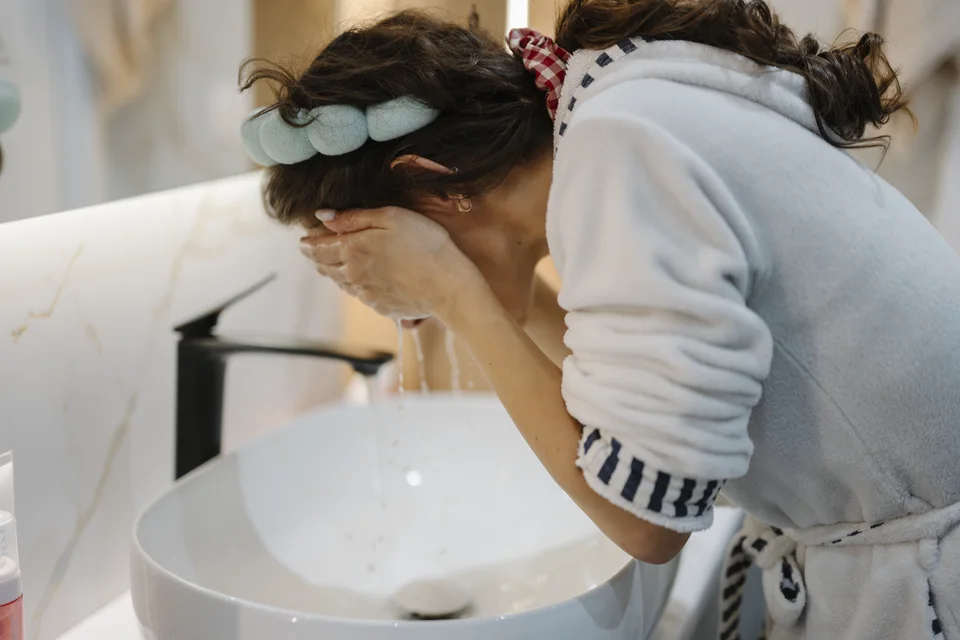
For a current U.S. K-beauty oil route, ma:nyo’s official page lists Pure Soybean Cleansing Oil at $23 sale price ($29 list) for 200 ml with Add to Cart visible. The brand says it turns milky with water and dissolves makeup and impurities. That is a manufacturer claim, not a K-Trend comparison result.
For a balm route, Banila Co’s official U.S. page lists Clean It Zero Cleansing Balm Original at $8 for the default 25 ml size, with 100 ml and 180 ml selectors and Add to cart visible. The brand describes it as a first step that melts face and eye makeup, then instructs users to massage on dry skin, add water to emulsify, and rinse. The $8 figure must not be silently attached to the larger sizes.
The format decision is behavioral. Oil is quick to dispense and easy to spread over a larger face area, but a pump bottle is less travel-friendly. Balm is compact and portionable with a spatula, but it adds a scoop-and-close step. Neither format wins because a celebrity clip went viral. Choose the one whose instructions you will follow without rushing the eye area.
Use needs-first logic: solve a missing function, not a celebrity clip.
Sticker density illustrates why size must stay visible: $23 divided by 200 ml is about $0.12 per ml; $8 divided by 25 ml is $0.32 per ml. That does not make the oil “2.8 times better value.” The products use different formats, the default Banila price is a travel size, and amount per cleanse is unknown. It only prevents the $8 headline from being mistaken for the price of a full-size jar.
The eye-area rule is pause, press, then reassess
- Read the label first. Confirm whether the remover is intended for eyes and waterproof makeup.
- Reduce motion. Let an appropriate saturated pad or product sit briefly according to directions instead of immediately rubbing back and forth.
- Reassess after one gentle pass. Remaining pigment may call for a dedicated eye product, not more pressure with the same method.
- Emulsify oils and balms fully. Follow the manufacturer’s water-and-rinse step rather than treating the first smear as the finish.
- Stop at irritation. Pain, persistent redness, or eye symptoms are not a challenge to cleanse harder.
Etude’s official Global Amore page illustrates the dedicated format: its 100 ml Lip & Eye Remover uses a water-and-oil layer and is marketed for heavy or waterproof point makeup. At the August 30 check it was $7.28 sale price but marked sold out, so it is not a current purchase recommendation. The useful information is the format and status—not a fake “best buy” badge on unavailable stock.
For retailer-channel context, see the OLIVE YOUNG/Sephora U.S. guide; it is not a stock receipt for these removers.
Use this final branch
| Your actual problem | Decision | Why |
|---|---|---|
| No residue, no repeated friction, no irritation | Keep your current routine | The viral clip creates no missing function |
| Heavy base or sunscreen resists a single gentle cleanse | Inspect ma:nyo oil or Banila balm | Both are current first-cleanse formats with official U.S. purchase paths |
| Waterproof eye makeup is the only problem | Use an in-stock eye-safe dedicated remover | A full-face oil purchase may solve more than you need |
| You are prone to irritation or over-cleansing | Wait and simplify | Double cleansing is conditional, not mandatory |
| You want proof that one product “won” the Tate video | Skip the conclusion | The clip lacks a controlled outcome |
The durable Tate McRae makeup answer is simple: the video cannot settle remover performance. Your removal load and friction tolerance can guide the format. Recheck U.S. price and stock before buying.
Sources and image notes
- Tate McRae, original branded TikTok, and Neutrogena, official Instagram response: primary campaign record.
- Neutrogena Tate McRae set and Hydro Boost wipes: official association, contents, claims, and directions.
- American Academy of Dermatology, Cleveland Clinic, and FDA eye-cosmetic safety guidance: independent care and safety boundaries.
- ma:nyo U.S., Banila Co U.S., and Global Amore Mall: current format, price, size, directions, and availability facts checked August 30, 2026.
- Featured photo: Patrick Cristiano, Tate McRae performing in Manila, CC BY 4.0. Cropped, resized, and converted to WebP; used only as performance context.
Method: Primary campaign and product pages establish the facts. K-Trend’s removal-load matrix turns them into a routine-planning tool.




.jpg)
