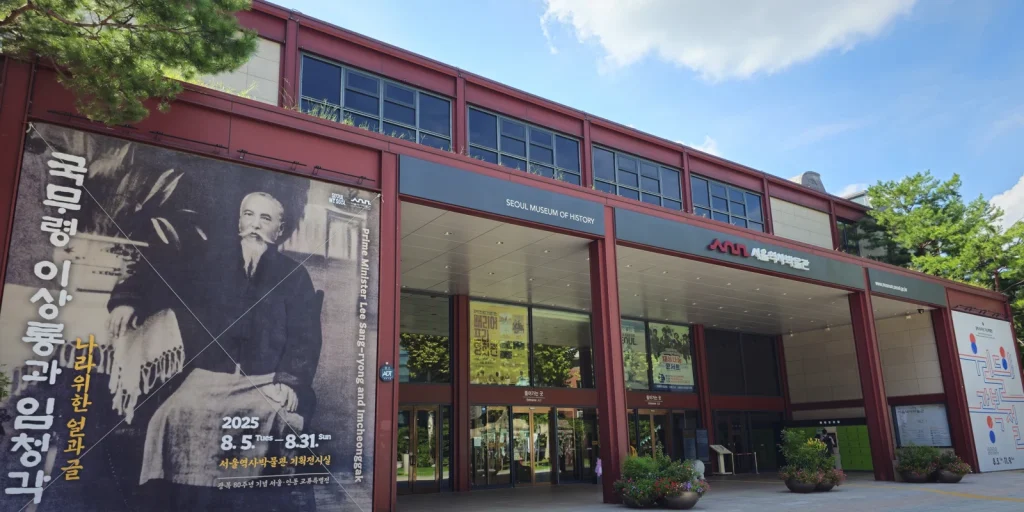
Seoul Museum of History parking calculates to ₩10,600 for a three-hour stay in the standard small-vehicle category, even though admission to the museum is free. The charge rises by ₩400 for every five minutes after the first hour. A longer family visit can therefore change the bill even when nobody buys an admission ticket.
The museum’s visitor information, checked September 30, 2026, gives the ordinary parking rate as ₩1,000 for up to one hour and ₩400 per additional five minutes. The calculations here use exact five-minute durations, no qualifying discount, and a vehicle carrying fewer than 20 people.
Every extra half hour adds ₩2,400
Separate the museum visit from the vehicle’s stay. Your parking clock can include unloading, a stop outside the exhibitions, and the time needed to return to the car. “Two hours in the museum” is not necessarily a two-hour parking charge.
| Parked time | Calculation after first hour | Total |
|---|---|---|
| 60 minutes | First-hour charge | ₩1,000 |
| 90 minutes | ₩1,000 + 6 × ₩400 | ₩3,400 |
| 120 minutes | ₩1,000 + 12 × ₩400 | ₩5,800 |
| 180 minutes | ₩1,000 + 24 × ₩400 | ₩10,600 |
Swipe the table on narrow screens. For these durations, the formula is ₩1,000 + ((minutes − 60) ÷ 5 × ₩400). Beyond the first hour, 30 ÷ 5 × ₩400 = ₩2,400 per extra half hour. Do not use this exact-boundary model to infer how a partial five-minute interval will be rounded at payment.
The posted prepaid daily rate is ₩22,000 for this vehicle category. That is a separately described daily option, not evidence that the ordinary timed bill automatically stops at that amount. Ask the parking operator how prepayment works before treating the daily rate as a cap.
A lunch break changes the transport comparison
Consider a chosen schedule with 90 minutes for exhibitions, 30 minutes for a meal or rest, and 30 minutes for arrival and departure tasks. The parking period is 150 minutes. Its model charge is ₩1,000 + 18 × ₩400 = ₩8,200. Removing the break reduces the model to 120 minutes and ₩5,800, a ₩2,400 difference.
This is a budget scenario, not an observed family visit. It makes a useful trade-off visible: free admission leaves parents free to stay longer, while the car keeps accumulating timed charges. A taxi or transit comparison should use the family’s real origin, return destination, group size, and luggage rather than a generic transport fare.
Our editorial view is to preserve the visit the family wants and compare transport around it. Cutting a worthwhile gallery stop purely to keep an arbitrary parking budget can defeat the reason for coming. Driving can still be the practical choice for a particular family; it just needs the actual parked duration and applicable rate.
Verify the date before optimizing the bill
The generic English visitor page is not the complete autumn schedule. The museum’s current Korean admission page extends Tuesday, Wednesday, Friday, Saturday, and Sunday opening to 9 p.m., with 8:30 p.m. last admission, from September 15 through November 30, 2026. Thursday remains 9 a.m.–6 p.m., with 5:30 p.m. last admission. Monday and January 1 are closure days; the Korean page specifies a public-holiday exception for Mondays. Confirm your actual date and branch instead of copying a general evening closing time.
This is the Seoul Museum of History at 55 Saemunan-ro, not the National Museum of Korea. The latter has a separate children’s booking process. A different indoor-outdoor plan needs the Botanic Park Monday check. If transit replaces the car, start with the family subway fare rules.
Official sources, checked September 30, 2026: Seoul Museum of History parking rates and current Korean autumn opening schedule. All parking totals are K-Trend calculations. The ordinary-rate examples exclude discounts, daily prepayment, and non-parking expenses.
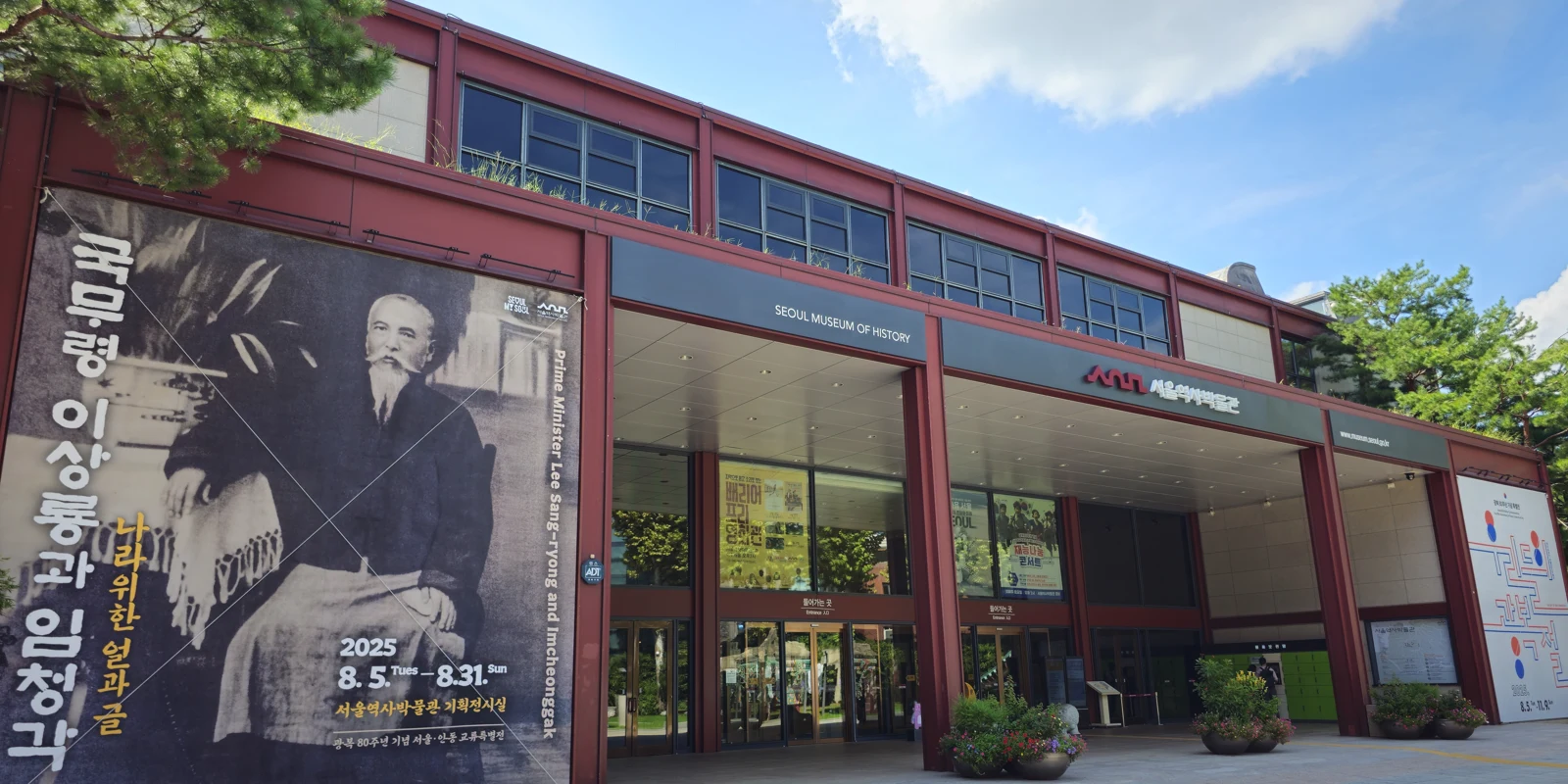
Archive photograph: Ellaline Seoul, August 26, 2025 · CC0. Proportionally resized and converted to WebP without cropping; the visible 2025 exhibition banners are not a current schedule. View the featured image.