
If an eligible Olive Young cart sits at $149 during September Members’ Week, adding a genuinely useful $1 item can cut the merchandise total from $129 to $110. The reason is not a secret sale. It is the jump from the $20-off-$100 coupon to the $40-off-$150 coupon.
That $19 advantage is real only if the item is eligible, the cart still clears $150 after other discounts, and no better promo is displaced. This guide locks the arithmetic, the checkout traps, and one awkward points contradiction on Olive Young’s own event page before you place the order.
$10 off → $50
$20 off → $80
$40 off → $110
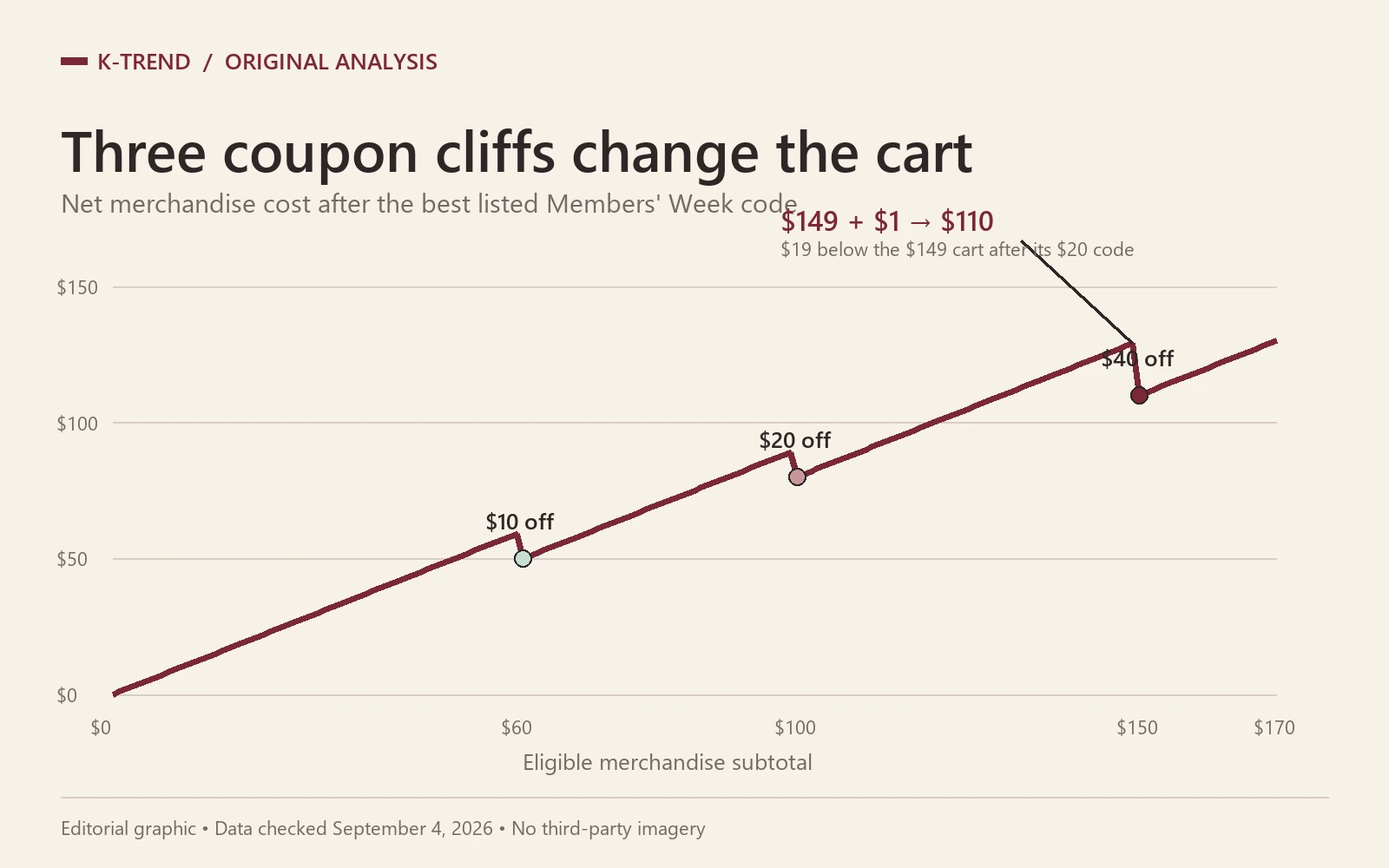
The $149 cart is the one worth stopping
Olive Young’s U.S. September Members’ Week page lists three all-tier coupon codes for September 1 through 7, Pacific Time: SEPMEM10 takes $10 off $60, SEPMEM20 takes $20 off $100, and SEPMEM40 takes $40 off $150. Only one promotion code can be used per order.
| Eligible subtotal | Code | Discount | Net merchandise | Effective discount |
|---|---|---|---|---|
| $60 | SEPMEM10 | $10 | $50 | 16.7% |
| $100 | SEPMEM20 | $20 | $80 | 20.0% |
| $150 | SEPMEM40 | $40 | $110 | 26.7% |
At $149, the $20 coupon leaves $129. If one additional eligible dollar lifts the merchandise subtotal to $150, the $40 coupon leaves $110. You spend $1 more before the coupon and $19 less after it. That is an unusually sharp threshold, not a general instruction to pad every cart.
The same logic is much weaker at $99. A $1 addition moves the order from $89 after the $10 coupon to $80 after the $20 coupon, an $9 net improvement. At $59, the first threshold can also reward a useful addition. But once a cart is comfortably above a tier and far below the next, adding products just to “maximize” a coupon usually means buying inventory you did not plan to own.
Use the subtotal Olive Young uses, not the number in your head
The event fine print says the minimum purchase is calculated on the merchandise subtotal after discounts and excludes tax and shipping. A $150 screen total padded by tax or a shipping charge does not necessarily unlock the $150 code. Product-level markdowns can also move the qualifying subtotal below the line.
There is a simple way to avoid a bad surprise: apply the code while the cart is editable, then read the discount line and merchandise subtotal before payment. If SEPMEM40 does not reduce the order by $40, do not assume checkout will repair itself later. Remove the filler item, compare the lower tier, and keep the cheaper valid basket.
One-code-only matters too. A shopper with another $25 code may be worse off switching to $40 off $150 if reaching the threshold requires $25 of extras. Compare the final merchandise charge under each valid code. Coupon face value is not savings until the basket needed to obtain it is counted.
The clean comparison is “planned basket” versus “threshold basket”
Start with the items you intended to buy before seeing the banner. Call that the planned basket. Then build a threshold basket containing only additions you would buy at ordinary price within the next few months. The decision is sound when the threshold basket’s final charge is lower and the added items are not likely to expire, duplicate something unopened, or trigger a return problem.
| Starting cart | Added item | Final coupon | Net merchandise | Editorial read |
|---|---|---|---|---|
| $149 | $1 item you will use | $40 off | $110 | Clear win if eligible |
| $141 | $9 practical refill | $40 off | $110 | Still $11 below the original $121 net |
| $121 | $29 impulse item | $40 off | $110 | You pay $9 more than the original $101 net |
The last row is the trap. A $121 cart qualifies for $20 off and lands at $101. Adding an unwanted $29 product to reach $150 produces a $110 net. The bigger coupon saves less money because the basket grew faster than the discount.
Points are not as settled as the coupon math
The coupon section is internally consistent. The points section is not. A promotional block on the same official page says Green members receive three-times points for a total of 6%. The fine print later says three-times the standard 1.5% equals 4.5%. Those cannot both describe the same base calculation.
For that reason, this article does not add a Green points value to the $110 result. Gold is stated as 8% in the fine print and Friend as 2%, but account eligibility, point timing, exclusions, cancellation, and eventual redemption still matter. Treat the coupon deduction visible at checkout as immediate value. Treat points as a separate, delayed benefit only after the account ledger confirms what posted.
This distinction becomes useful when comparing an item such as the current No. 1 MEDIHEAL mask snapshot. The displayed product price can be checked now; future points depend on the event and your account. K-Trend’s earlier Olive Young versus Sephora channel guide makes the same broader point: availability and channel convenience are not interchangeable with the lowest checkout total.
Free shipping does not rescue a wasteful cart
Olive Young’s current U.S. events page states that standard shipping is free on orders of $35 or more through December 31, 2026. All three Members’ Week coupon thresholds already exceed $35 before the coupon, so a shopper should not need to climb from $149 to $150 merely to unlock standard shipping. Still, confirm the shipping line because destination and service restrictions can matter.
New members may also see a five-point welcome offer. The official welcome-points page says five points equal $5, expire after 30 days, and may be used toward shipping. That is useful, but it should not be silently stacked into this coupon model. The Members’ Week terms say promotion codes are not stackable, while points are governed by their own account and redemption rules. Checkout is the final arbiter.
A five-minute checkout audit
- Freeze the planned basket. Screenshot or note the items you intended to buy before adding threshold fillers.
- Read the eligible merchandise subtotal. Exclude tax and shipping; account for product discounts.
- Test the best valid code. Compare the actual final merchandise charge, not the banner’s largest number.
- Value additions honestly. Count a threshold item only if you would otherwise buy and use it.
- Separate points. Record the posted point rate after purchase, especially if you are Green.
- Keep the terms. Save the event-page and order-summary evidence until the order and points settle.
If the basket includes color cosmetics, K-Trend’s narrower guides on muted Korean blush visibility and mascara removal trade-offs can help decide which addition is actually useful. A threshold item that does not suit the wear or removal routine is not a bargain.
Editorial evaluation
K-TREND ORIGINAL ANALYSIS: The $150 tier is the strongest offer of the three because its effective discount is about 26.7% at the line, compared with 20% at $100 and 16.7% at $60. But the offer is only exceptional in a narrow band. Between roughly $141 and $149, a planned refill can lower the net basket. At $121, a large filler can make the “better” coupon cost more.
EDITORIAL EVALUATION: My view is to treat $149 as a stop-and-calculate moment, not a shopping challenge. Add the dollar if the product is eligible and useful. Do not build a $150 routine around a coupon if the planned basket was close to $100. The strongest consumer move is often the smaller cart with a smaller code.
Conditional outlook through September 7
The published event window ends September 7 in Pacific Time. Product stock, markdowns, account eligibility, and on-site messaging can change before then. The coupon arithmetic remains valid only while the three thresholds and one-code rule remain unchanged. The unresolved Green points conflict is the most likely part of this guide to require clarification; verify the rate in your account instead of planning the order around either 6% or 4.5%.
After the event closes, the useful part of this analysis is the method: compare the planned basket with the threshold basket, apply discounts before tax and shipping, and refuse to call points cash until they post and can be redeemed.
Sources and method
- Olive Young U.S. September Members’ Week: dates, coupon codes, thresholds, one-code rule, subtotal basis, and points language.
- Olive Young U.S. events: current free-standard-shipping statement.
- Olive Young welcome points: value, expiration, and stated shipping use.
All dollar outcomes are K-Trend calculations from the cited official thresholds. They exclude tax, shipping exceptions, returns, product exclusions, point redemption, and any unlisted promotion. No affiliate links, purchase commissions, product testing claims, or generative images are used.




.jpg)
